
E-Invoicing in UAE
Be Ready for the 2026–27 Mandate
Microvista Technologies e-Invoicing Software UAE is fully aligned with the Federal Tax Authority (FTA) guidelines and built to simplify your PEPPOL-based e-Invoicing journey. As one of the most reliable and business-friendly solutions, we make your FTA compliance seamless, fast, and future-ready.





Why This Platform Matters
Why Businesses Should Act Now
UAE E-Invoicing Timeline (Mandatory Phases)
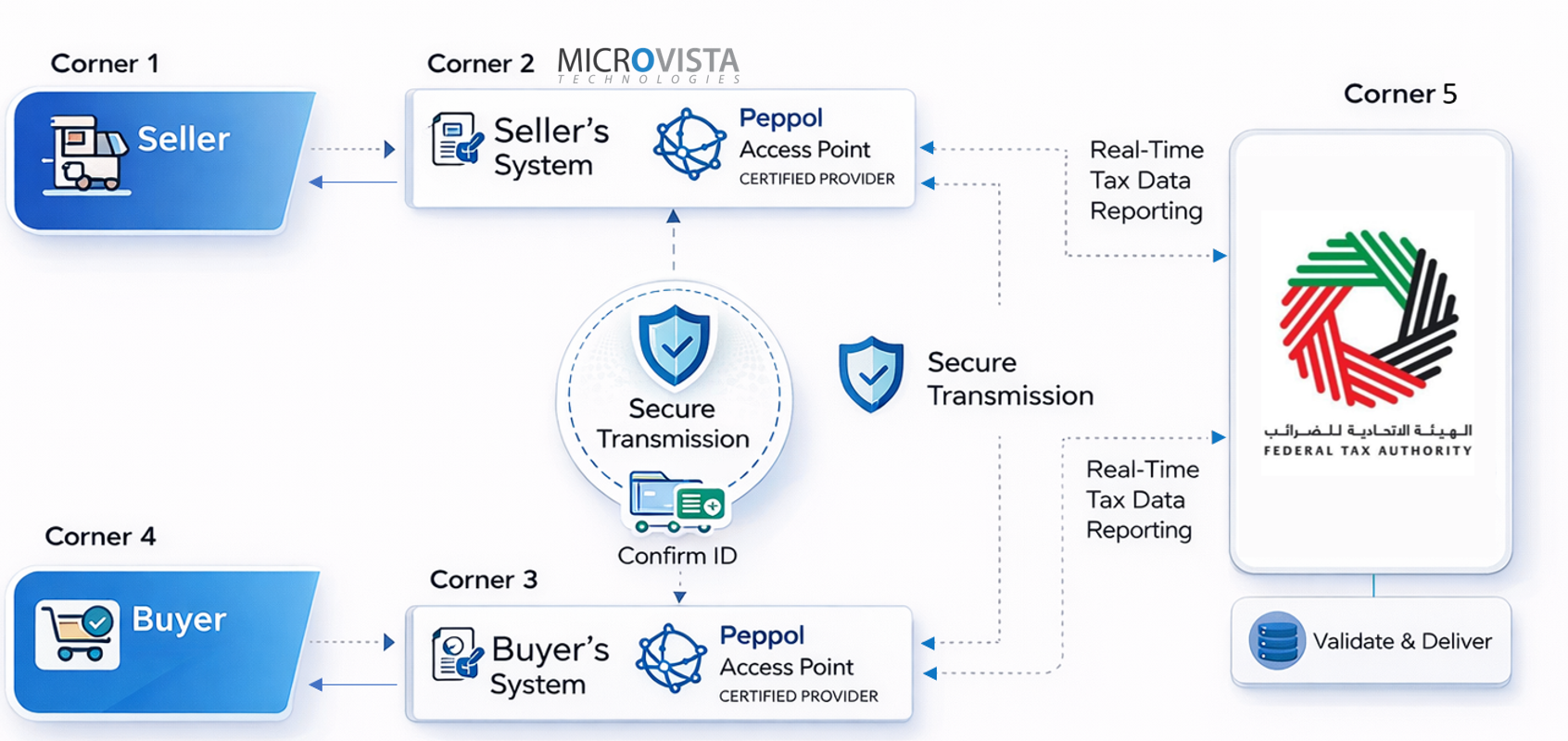
How UAE E-Invoicing Works


Why Microvista for e-Invoice in UAE ?
e-Invoice generation process in PEPPOL
Frequently ask Questions
Want to ask something on e-Invoicing in UAE?
An invoice issued, transmitted, and received, through the Electronic Invoicing System, in a structured electronic format that enables automatic and electronic processing, in accordance with the Electronic Invoicing System.
The invoice has to be exchanged between the seller and the buyer via an Accredited Service Provider who would transmit the invoice in the form of an XML and the Accredited Service Provider will also report the invoice data to the FTA.
E-Invoice software is a digital solution that generates, transmits, and stores invoices in a structured electronic format compliant with government regulations. It ensures real-time validation, secure exchange, and seamless integration with tax authorities and business systems.
E invoice will be implement in UAE phase wise.
In phase 1
Business having turnover more than 50M AED are covered. They have to appoint ASP before 31st July 2026 and start e invoicing by 1st January 2027.
In phase 2
Business having turnover equals or less than 50M AED are covered. They have to appoint ASP before 31st march 2027 and start e invoicing by 1st July 2027.
In phase 3
government entity have to appoint ASP by 31st march 2027 and start e invoicing in 1st October 2027.
The business should analyse their transactions and the resulting invoicing data against the data dictionary and ensure that they are compliant. Once the list of Accredited Service Providers is published by MoF, the businesses need to enter into a commercial arrangement with one of them and work on the integration between their systems to transmit the invoice.
Benefits include cost savings, faster invoice processing, reduced errors, improved transparency, and better compliance with regulatory requirements.
Businesses can adopt e-Invoicing by selecting a certified e-Invoicing solution provider, registering with the necessary authorities, and integrating the chosen solution into their invoicing processes.
Businesses in the UAE must engage with an Accredited Service Provider to issue and receive e Invoices. The buyer's electronic address (endpoint) will be used to share the invoice over the Peppol network.
The Federal Tax Authority (FTA) is the official regulatory body responsible for overseeing the implementation, compliance, and monitoring of the e-Invoicing process in the UAE.
UAE has adopted the Peppol (Pan-European Public Procurement Online) framework as the standard for e-Invoicing. It facilitates interoperability between different e-Invoicing platforms.
In case of self-billing, the buyer (customer) should create the eInvoice and will exchange the document with the seller and will also report to the FTA via the Accredited Service Provider.
Currently, the scope of UAE eInvoicing includes only B2B and business-to-government (B2G) transactions. However, if a taxpayer wishes to issue B2C invoices through the eInvoicing network, this can be decided between the taxpayer and their Accredited Service Provider, but such invoices should not be reported to Corner-5.
Yes, e-Invoicing can benefit small businesses by reducing manual processes, minimizing errors, and improving overall efficiency in the invoicing cycle.
The businesses are not required to interact directly with the UAE PEPPOL Authority. Instead, the Accredited Service Provider (ASP) will liaise with the UAE PEPPOL Authority on their behalf.
The UAE government has introduced initiatives to encourage e-Invoicing adoption, and businesses should explore potential incentives or support programs.
Each member of the VAT group must have an endpoint via a UAE Accredited Service Provider.
Should there be an issue with the invoice, the Accredited Service Provider shall return the invoice to the issuer.
The exchange of eInvoices between the seller and buyer will be carried out in XML format and it will not involve any PDFs. It is pertinent to mention that these XML would be encrypted and will follow the industry standard security protocols.
The data retention requirements are consistent with current law, which mandates a retention period of 7 years.
Yes, Microvista is supporting generation of bulk invoices.
Self-billing refers to the scenario where the buyer is authorised by the seller to issue the invoice, not the reverse charge mechanism.
It will be the Tax identification number (TIN) which is the first 10 digits of the Tax registration number (TRN) issued to the business. For the businesses which are not registered with the FTA (i.e. they don’t have a TRN), they would need to register with the FTA to get a TIN.
In case of any errors in tax invoices, a credit note is required to be issued for its rectification.
It is the obligation of the seller (UAE business) to ensure that the eInvoice generated is compliant to the UAE PINT framework and the eInvoice is reported to the FTA through their Accredited Service Provider. The transmission of the invoice to the buyer can be managed outside the Peppol network wherein the seller can generate a PDF and transmit to the buyer (overseas business in a none Peppol-compliant country).

Request a Demo
For
Get in touch to discuss your project