E-Invoicing in Oman

Prepare Your Business for Oman’s Fawtara E-Invoicing

Microvista Technologies provides an integrated e-Invoicing solution designed to help businesses prepare for Oman’s Fawtara framework. Connect your ERP, accounting or billing system, validate invoice data, exchange structured electronic invoices and manage your e-Invoicing processes through a secure digital platform.


e-Invoicing-banner-image-oman
encryption-image
privacy-image
database-image
database-image
database-image

Why This Platform Matters

Fawtara-Ready Invoice Processing

Prepare your invoicing environment for Oman’s electronic invoicing framework with structured invoice data, automated validation and configurable business workflows.

Connected 5-Corner Architecture

Support electronic invoice exchange between suppliers, service providers, buyers and the Oman Tax Authority through the Fawtara operating model.

ERP & Accounting Integration

Connect your existing ERP, accounting or billing application with the e-Invoicing platform while keeping your existing business processes largely intact.


Why Businesses Should Act Now


Know Your Implementation Window

Oman is introducing Fawtara progressively. Businesses should determine their applicable implementation period and plan their technology and compliance activities accordingly.


Assess Your ERP Readiness

Your ERP or billing system needs to provide the information required for structured e-Invoicing. Reviewing invoice fields and master data early helps identify integration gaps.


Prepare Your Invoice Data

Customer, supplier, tax, item, unit of measure and transaction information must be accurately mapped to the required electronic invoice structure.


Test Before Go-Live

Integration testing, validation testing and user acceptance testing should be completed before production invoicing begins.


Reduce Invoice Rejections

Pre-validation can identify missing or inconsistent information before an invoice enters the electronic exchange process.


Plan Your Archiving Strategy

E-Invoicing implementation should include a clear approach for retaining, retrieving and protecting electronic invoice records in accordance with applicable Oman requirements.

Benefits of E-invoicing in Oman

Faster Invoice Processing

Automate invoice generation and electronic exchange while reducing manual intervention.


Improved Data Accuracy

Structured invoice data and validation rules help reduce errors and inconsistencies.


Better ERP Integration

Connect e-Invoicing with your existing ERP, accounting or billing environment.


Simplified Reconciliation

Digital invoice information can support faster matching between sales, receivables, tax and accounting records.


Secure Digital Records

Maintain electronic invoice records for easier retrieval, review and audit support.


Improved Operational Visibility

Track invoice status, validation results and transmission activity through a centralized platform.


Oman E-Invoicing Timeline (Fawtara Implementation Phases)

August 2026

Initial Pilot – Selected Large Taxpayers

The initial rollout began with selected large VAT-registered companies identified by the Oman Tax Authority.

1 April 2027

Businesses with Annual Supplies Above OMR 5 Million

Under the current statutory framework, taxable persons whose annual supplies exceed OMR 5 million are subject to the first mandatory commencement date.

1 October 2027

Businesses with Annual Supplies Up to OMR 5 Million

Taxable persons whose annual supplies do not exceed OMR 5 million fall under the subsequent mandatory commencement date.

August 2028

Government Entities

Separate Government Rollout
The implementation schedule for government institutions and entities is subject to further announcement by the Oman Tax Authority.
Check the latest OTA guidance and rollout checker before finalizing your implementation plan.

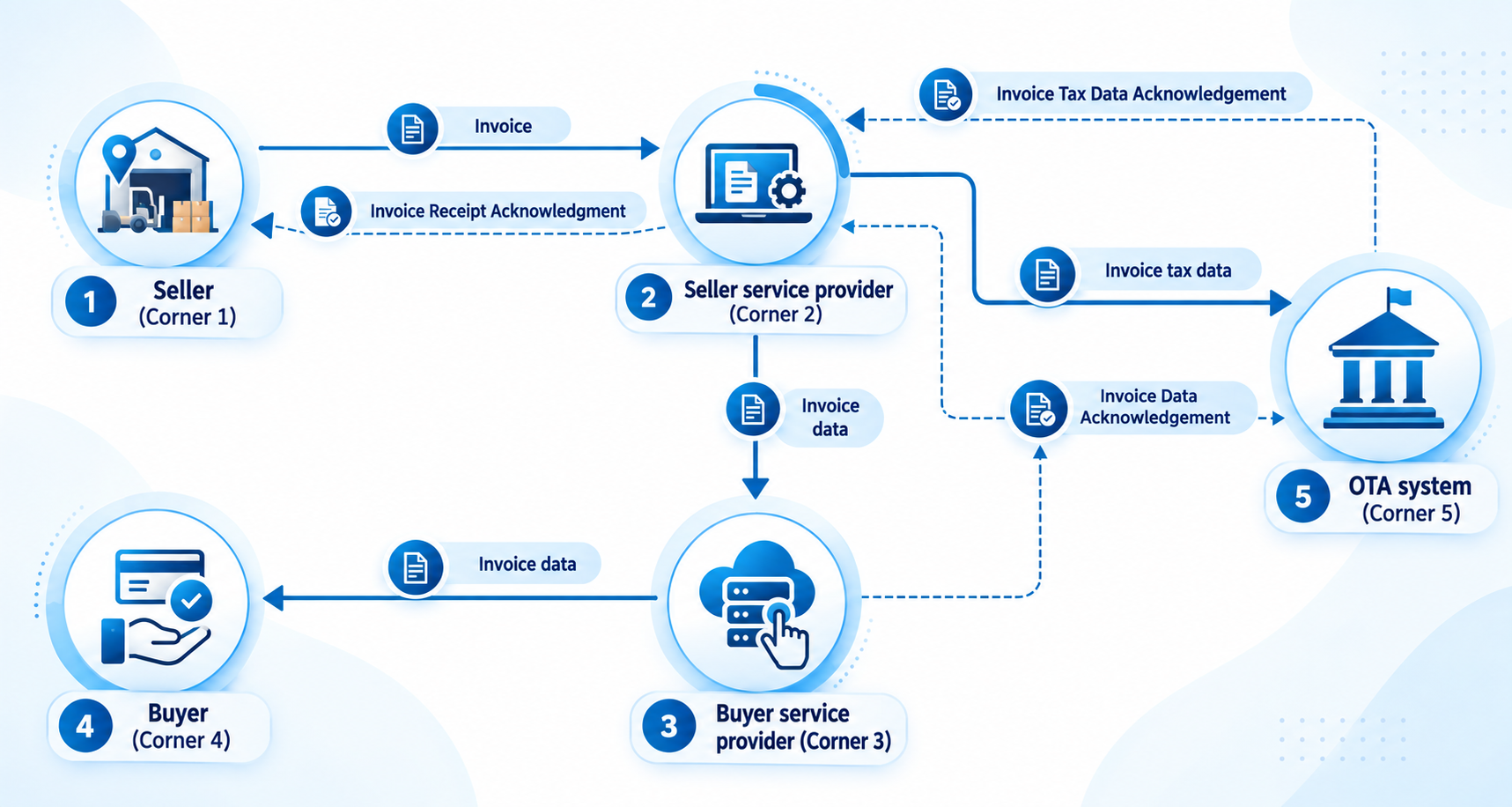
How OMAN E-Invoicing Works

Corner 1 – Supplier

Invoice Creation

The supplier creates the invoice through its ERP, accounting software, billing system or other connected application.


Corner 2 – Supplier Service Provider

Validation & Processing

The supplier’s service provider receives the invoice data, validates it against applicable technical and business rules and prepares it for electronic exchange.

Corner 3 – Buyer Service Provider

Electronic Exchange

The invoice is exchanged with the buyer’s service provider through the Fawtara electronic invoicing ecosystem.


Corner 4 – Buyer

Invoice Receipt

The buyer receives the electronic invoice through its connected service provider for further processing within its accounting or ERP environment.

Corner 5 – Oman Tax Authority

Tax Data Reporting

The required tax information is reported to the Oman Tax Authority as part of the Fawtara framework.


Acknowledgment & Record Management

Tracking and Archiving

Processing results, acknowledgments and relevant electronic records can be retained to support reconciliation, audit and compliance activities.

Why Microvista for e-Invoice in OMAN ?

ERP-Ready Integration

Microvista integrates with ERP and accounting environments to help businesses introduce e-Invoicing without redesigning their complete invoicing process.


Pre-Transmission Validation

Invoice information can be validated before transmission, helping businesses identify data issues at the source.


PINT-OM & Data Mapping Support

Microvista can support field-level assessment and mapping between existing ERP invoice data and the applicable Oman e-Invoicing requirements.

Flexible Integration

Support business environments through cloud-based solutions and integration models suitable for ERP, accounting and billing systems.


High-Volume Processing

Designed to support high-volume electronic invoice processing and can be configured for businesses with multiple entities, branches and transaction sources.


Implementation Support

Microvista can support the implementation journey across requirement assessment, data mapping, integration, testing, UAT and go-live activities.


e-Invoice generation process in PEPPOL
powerGST_flow

Frequently ask Questions

Want to ask something on e-Invoicing in OMAN?

Fawtara is Oman’s electronic invoicing initiative introduced by the Oman Tax Authority to establish a standardized digital process for issuing, exchanging and reporting electronic invoices.

The Oman Tax Authority (OTA) is responsible for administering the Fawtara e-Invoicing framework

The Fawtara model consists of the supplier, supplier service provider, buyer service provider, buyer and Oman Tax Authority. It enables electronic invoice exchange and tax data reporting within the defined ecosystem.

PINT-OM is the Oman-specific implementation of the Peppol International invoicing model and provides the applicable technical framework for supported electronic invoice documents and validation.

Businesses should follow the latest OTA-approved technical specifications and PINT-OM documentation for applicable structured invoice formats and human-readable representations.

Yes. VAT-registered businesses are being brought into the Fawtara framework progressively, with the applicable phase determined by the current rollout requirements.

The applicable implementation date depends on the current Fawtara rollout requirements and the taxpayer’s circumstances, including annual taxable supplies. Businesses should use the latest OTA guidance and rollout-checking facility.

Businesses may prepare and, where permitted under OTA processes, adopt e-Invoicing ahead of their mandatory implementation period. The applicable onboarding and technical requirements should be confirmed with OTA.

bg

Request a Demo
For

Get in touch to discuss your project

circle